AI writing has changed the way people create content. A few years ago, writers mostly used AI for simple ideas or quick rewrites. Today, the best AI writing tools can help with blog posts, emails, product descriptions, social media copy, research, editing, and even creative writing.
But there is one problem: there are too many tools to choose from.
Some are great at writing natural long-form content. Others are better for editing, marketing, SEO, or business workflows. Choosing the right one depends on what you actually need.
We looked at the leading AI writing platforms available in 2026 and compared them by writing quality, flexibility, editing features, use cases, and overall value. Current comparisons consistently place tools such as ChatGPT, Claude, Jasper, Grammarly, Copy.ai, and Writesonic among the major options, although their strengths are quite different.
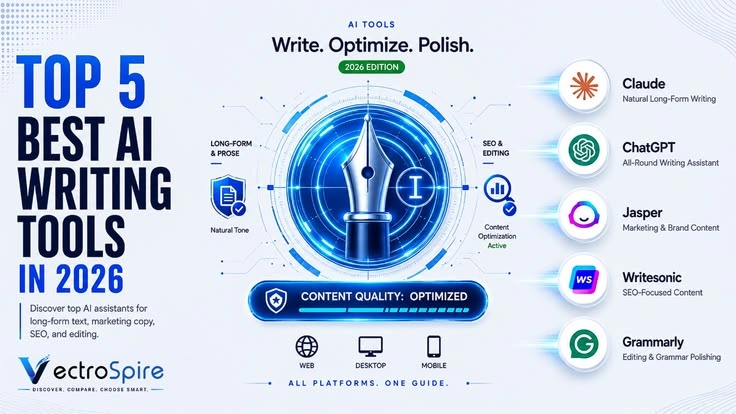
If you want a simple answer, ChatGPT is the best overall choice for most writers, while Claude is a strong option for natural long-form writing. Grammarly is better when you already have content and want to improve it.
Key Takeaways
- ChatGPT is the best all-around AI writing tool for most users.
- Claude is excellent for natural, detailed, long-form writing.
- Grammarly is ideal for editing, grammar, clarity, and tone.
- Jasper is useful for marketing teams that need consistent brand content.
- Writesonic is worth considering for SEO-focused content workflows.
- Copy.ai works well for sales and marketing workflows.
- The best AI writing tool depends on your specific writing needs.
- AI should support human writers, not replace fact-checking and human judgment.
What Are AI Writing Tools?
AI writing tools are software platforms that use artificial intelligence to create, rewrite, edit, or improve text. You can give them an instruction, topic, outline, or existing paragraph, and they can help turn that input into usable content.
Modern tools can do much more than generate a basic article. They can suggest headlines, change the tone of a paragraph, shorten long sentences, create email drafts, summarize information, generate ideas, and help organize content.
The important difference is that each tool approaches writing differently. General AI assistants give you more freedom, while specialized platforms often provide templates and built-in workflows.
Best AI Writing Tools in 2026
1. ChatGPT — Best Overall
ChatGPT is one of the most flexible choices for writing in 2026. It can help with almost any type of written content, from blog posts and emails to reports, scripts, product descriptions, and brainstorming.
Its biggest advantage is flexibility. You can start with a simple idea and gradually develop it into an outline, draft, edited version, and final copy in the same workspace.
It is also useful when you want to control the writing style. You can ask for shorter sentences, a friendly tone, a professional voice, or simpler language.
For writers who want one AI tool that can handle many different tasks, ChatGPT is a strong overall choice.
Best for: General writing, brainstorming, articles, emails, rewriting, and content planning.
2. Claude — Best for Natural Long-Form Writing
Claude has become a popular choice for writers who care about natural-sounding long-form content. Current 2026 comparisons frequently highlight its prose quality and ability to handle detailed writing tasks.
It can be especially useful for articles, essays, reports, explanations, and other content where flow matters. Its writing often feels less rigid when the prompt gives it enough context about the audience and desired style.
Claude is not necessarily the best choice for every workflow, but writers who want thoughtful, readable prose should give it a try.
Best for: Long-form articles, essays, detailed explanations, and rewriting.
3. Grammarly — Best for Editing
Not every writer needs an AI tool to create content from scratch. Sometimes the words are already there but need improvement.
That is where Grammarly is useful. It can help identify grammar problems, improve clarity, adjust tone, and make sentences easier to understand. This makes it a useful second step after writing a draft.
For professional emails, website copy, assignments, and business communication, an editing-focused tool can sometimes be more valuable than another content generator.
Best for: Grammar, proofreading, clarity, tone, and polishing existing content.
4. Jasper — Best for Marketing Teams
Jasper is built more around marketing than general writing. It is designed for businesses and teams that produce content regularly and want consistency across their campaigns.
One of its main advantages is brand-focused content creation. Marketing teams can use specialized workflows and brand guidelines to keep content closer to their preferred voice.
That makes Jasper more useful for companies producing large amounts of marketing material than for someone who only needs an occasional blog post. Recent 2026 comparisons also describe Jasper as increasingly focused on marketing teams and brand-controlled content.
Best for: Marketing teams, brand content, campaigns, and business copy.
5. Writesonic — Best for SEO Content Workflows
Writesonic is aimed at businesses and creators who want AI-assisted content combined with SEO and visibility features.
It can be useful when content production is part of a larger SEO workflow rather than simply asking an AI to write a paragraph.
However, SEO software should not be treated as a shortcut to rankings. A good article still needs original value, accurate information, useful answers, and a reason for readers to trust it.
Best for: SEO content, content teams, and high-volume publishing workflows.
6. Copy.ai — Best for Sales and Marketing Workflows
Copy.ai has moved beyond simple copywriting templates and is increasingly focused on sales and go-to-market workflows. That makes it more attractive to businesses that need repeated marketing or sales tasks rather than occasional writing.
It can help create promotional copy, sales messages, emails, and other short-form business content.
For someone writing a personal blog, it may offer more features than necessary. For a sales or marketing team, those workflows can be useful.
Best for: Sales copy, marketing messages, and business workflows.
How to Choose the Right AI Writing Tool
The best AI writing tool is not automatically the one with the most features. Start with your actual writing problem.
If you write different types of content every day, choose a flexible general-purpose tool such as ChatGPT or Claude.
If you already write your own content but struggle with grammar and sentence flow, an editor such as Grammarly may be the better choice.
If you manage a marketing team, look for features such as brand voice, collaboration, templates, and campaign workflows.
If SEO content is your main focus, choose a platform that fits your complete research, optimization, and publishing process rather than relying on AI-generated text alone.
Price also matters. AI writing platforms change their plans and pricing regularly, so it is smart to check the current pricing page before subscribing. Recent comparisons show significant differences between general AI assistants and specialized marketing platforms.
How to Use AI Writing Tools Without Making Your Content Sound Robotic
AI can save time, but simply copying the first generated draft is rarely the best approach.
Start with your own idea and give the tool enough context. Tell it who the reader is, what you want to explain, and what tone you prefer.
Then edit the result yourself.
Add your own examples, opinions, experience, observations, and useful details. Remove repeated phrases and anything that sounds unnatural. Most importantly, check facts before publishing.
This human review matters because AI can produce confident-sounding information that is incomplete or incorrect.
Google’s guidance focuses on helpful, reliable, people-first content rather than rewarding content simply because it was or was not produced with AI. The real goal should be creating something useful for the reader.
Why Human Input Still Matters
E-E-A-T stands for Experience, Expertise, Authoritativeness, and Trustworthiness. AI can help with research, structure, and drafting, but it cannot automatically give an article genuine personal experience or professional expertise.
For stronger content, explain things from real experience when appropriate, use reliable sources for important claims, identify knowledgeable authors, and correct mistakes before publication.
This is especially important for topics involving health, money, law, technology, or other areas where inaccurate information can cause real problems.
A useful AI draft is only the starting point. Human judgment is what turns it into trustworthy content.
Are AI Writing Tools Worth It?
For most writers, yes, but only when they solve a real problem. A blogger can use AI to create an outline and overcome writer’s block. A business can use it to draft emails. A marketing team can use it to speed up repetitive content tasks. An editor can use it to improve clarity and find mistakes.
The biggest benefit is not replacing writing completely. It is reducing the time spent on repetitive work so you can spend more time on ideas, research, editing, and strategy.
Final Verdict
There is no single tool that is perfect for everyone. ChatGPT is the best overall AI writing tool for most people because it is flexible and can handle many different writing tasks. Claude is a strong choice for natural long-form writing, Grammarly is excellent for editing, Jasper is better suited to marketing teams, Writesonic fits SEO-focused workflows, and Copy.ai is useful for sales and marketing operations.
The smartest approach is to choose a tool based on your workflow instead of chasing every new AI platform.
Use AI for speed. Use your own judgment for quality. That combination produces content that is faster to create and much more useful to real readers.
FAQs
What is the best AI writing tool in 2026?
ChatGPT is the best overall choice for most users because it can handle many types of writing. However, Claude may be better for writers who mainly create long-form content, while Grammarly is better for editing.
Which AI writing tool produces the most natural content?
Claude is frequently rated highly for natural long-form writing. However, the final quality also depends heavily on the instructions, context, editing, and examples you provide.
Are AI writing tools good for SEO?
They can be useful for research, outlining, drafting, and editing, but AI alone does not guarantee better rankings. Content should provide genuine value, be accurate, original, and written for people first.
Can AI writing tools replace human writers?
Not completely. AI can speed up many writing tasks, but human writers are still needed for experience, judgment, fact-checking, original ideas, and final editing.
Is Grammarly an AI writing tool?
Yes. Grammarly uses AI features to help users improve writing, including clarity, tone, grammar, and style. It is particularly useful when you already have a draft and want to polish it.
Should I use more than one AI writing tool?
You can. A practical workflow might use one tool for drafting and another for editing or research. The important thing is not how many tools you use but whether each one genuinely improves your writing process.