Choosing between Claude and ChatGPT is no longer as simple as picking the AI with the bigger name. Both tools can write, code, research, analyze information, and handle complex instructions. But they feel different when you actually use them.
In this Claude vs ChatGPT comparison, we look at their current capabilities, writing quality, coding performance, research features, ease of use, and everyday value. The goal is simple: help you decide which AI fits your needs better.
As of September 2026, OpenAI has introduced GPT-6 Astra for advanced work, while Anthropic has continued developing its Claude Fable family, including Fable 5.1. GPT-6 Astra is currently rolling out to a limited set of organizations rather than being generally available.
Key Takeaways
Using both can be useful when different tasks require different strengths.Claude vs ChatGPT: Quick Comparison
ChatGPT is the better all-round AI platform for many users.
Claude is excellent for writing, long documents, coding, and focused knowledge work.
Both are highly capable for programming and research.
Claude has strong long-context capabilities.
ChatGPT offers a broader productivity ecosystem.
Neither AI should be trusted blindly for important facts.
Your personal workflow matters more than benchmark rankings.
Claude vs ChatGPT: Quick Comparison
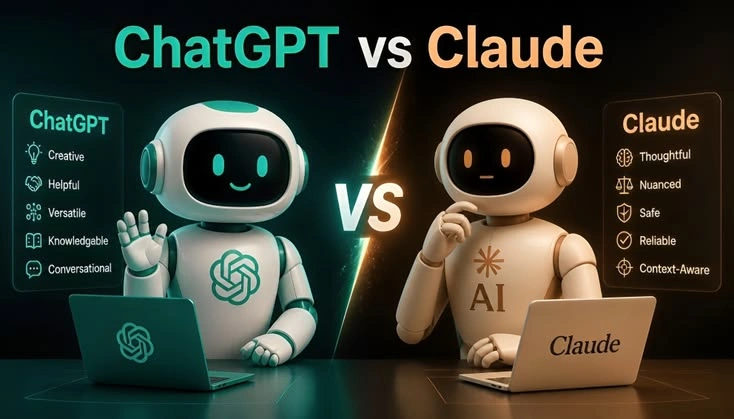
At a glance, both platforms are powerful, but their strengths are slightly different.
| Feature | Claude | ChatGPT |
|---|---|---|
| Writing | Excellent | Excellent |
| Coding | Excellent | Excellent |
| Research | Very strong | Very strong |
| Long documents | Excellent | Excellent |
| Everyday conversations | Natural and focused | Flexible and interactive |
| Complex reasoning | Excellent | Excellent |
| Creative work | Strong | Strong |
| Business tasks | Strong | Strong |
| Advanced agents | Strong | Strong |
| Best for | Long-form work and focused tasks | All-purpose AI and varied workflows |
There is no universal winner. The better choice depends on what you want to do with the AI.
What Is Claude?
Claude is an AI assistant developed by Anthropic. It is designed around useful, reliable, and responsible AI assistance, with a strong focus on writing, coding, reasoning, and professional work.
Anthropic’s current Claude lineup includes models such as Fable 5.1, Opus 5, Sonnet 5, and other specialized models. Fable 5.1 is positioned as Anthropic’s most capable model for coding and knowledge work, while Opus and Sonnet models target different levels of performance and efficiency.
One of Claude’s biggest advantages is its ability to work comfortably with large amounts of information. Anthropic’s Sonnet models have offered context windows reaching up to 1 million tokens, which can be useful when working with lengthy documents or large coding projects.
Claude also has a reputation for producing writing that feels structured and less cluttered. For users who regularly work with articles, reports, documentation, or long instructions, that can make a noticeable difference.
What Is ChatGPT?
ChatGPT is OpenAI’s AI assistant and has developed into a broad productivity platform rather than simply a chatbot.
OpenAI’s latest generation includes GPT-6 Astra, which was announced in September 2026 with improvements in coding, research, computer use, and complex multi-step tasks. It can also create documents, spreadsheets, and presentations while adapting to changing instructions.
ChatGPT has also expanded beyond basic text conversations. Depending on the plan and availability, users can work with files, images, voice, coding tools, research features, and connected services.
That wider ecosystem is one of ChatGPT’s biggest advantages. You can use it for a quick question in the morning, coding in the afternoon, and document or research work later without changing platforms.
Claude vs ChatGPT for Writing
Writing is one area where both platforms perform extremely well.
Claude often produces clean, natural-sounding long-form writing. It tends to follow tone instructions carefully and can be particularly useful for articles, reports, documentation, editing, and rewriting.
ChatGPT is also a strong writing assistant, but its biggest advantage is flexibility. You can ask it to make the same piece more professional, casual, persuasive, shorter, simpler, or more conversational and continue refining it through several rounds.
For bloggers, marketers, students, and business users, the difference may come down to personal preference.
Choose Claude if: you want focused, polished long-form writing.
Choose ChatGPT if: you want a flexible writing partner that can quickly change style and direction.
Claude vs ChatGPT for Coding
The coding competition is much closer.
Claude has become especially popular among developers working on large codebases and complex software projects. Anthropic has repeatedly focused its newer models on coding, agents, tool use, and long-running development tasks. Sonnet 5, for example, was introduced with major improvements in coding and agentic work.
ChatGPT is also highly capable for programming. OpenAI has positioned its newer models around coding, debugging, software development, and multi-step tool use. GPT-5.4 and GPT-5.5 both emphasized professional coding and agentic workflows, while GPT-6 Astra continues that direction.
For simple programming questions, both are excellent. For large projects, the better choice may depend on your coding environment and the tools you use.
Which Is Better for Research?
This is another close contest.
ChatGPT has strong research and information-handling features, making it useful when you need to explore a topic, organize findings, compare ideas, or turn research into a readable answer.
Claude is also designed for knowledge work and long-context tasks. Anthropic’s latest models emphasize research, professional work, coding, and handling complex tasks.
For everyday research, either can work well. The important point is not to treat either AI as automatically correct. Even powerful models can misunderstand information or make mistakes, so important facts should still be checked against trustworthy sources.
Which AI Is Easier to Use?
ChatGPT has an advantage if you want one platform that can handle many different types of tasks.
Its ecosystem has expanded into writing, coding, research, voice, files, images, and other productivity features. OpenAI has also continued adding tools that make ChatGPT useful for professional workflows.
Claude keeps its experience more focused. That can actually be an advantage if you mainly want a powerful assistant for writing, coding, analysis, and knowledge work without needing a huge collection of features.
In simple terms, ChatGPT feels like a broader AI workspace, while Claude feels like a focused AI collaborator.
Claude vs ChatGPT for Long Documents
Claude has traditionally been particularly strong for long-context work. Anthropic’s Sonnet models have offered a 1 million token context window, giving users significant room for large documents and extended coding tasks.
ChatGPT is also capable of handling substantial documents and complex projects, with OpenAI continuing to improve its context handling and professional workflows.
If your main job involves reviewing large reports, documentation, transcripts, or codebases, Claude deserves serious consideration. If you need document analysis alongside many other AI tools, ChatGPT may be more convenient.
Claude vs ChatGPT: Which One Should You Choose?
There is no reason to choose based only on benchmark scores.
Choose Claude if your priority is long-form writing, large documents, focused coding work, or a clean experience for serious knowledge tasks.
Choose ChatGPT if you want a versatile AI that can move between writing, research, coding, files, voice, images, and productivity tasks.
For developers, writers, students, researchers, and business users, both are capable enough to become daily tools. The real difference appears when you use them repeatedly for your specific workflow.
Our Verdict
So, who wins the Claude vs ChatGPT battle?
For overall versatility, ChatGPT is the stronger all-purpose choice. Its wider range of tools makes it useful for people who want one AI platform for many different jobs.
For focused writing, long-context work, and certain coding workflows, Claude can be the better choice. Anthropic’s latest models show how seriously the company is targeting professional knowledge work and software development.
The smartest approach may actually be to use both. AI tools are changing quickly, and today’s winner may not be tomorrow’s winner. Instead of asking which platform is absolutely better, ask which one gives you better results for the work you actually do.
At Techdova, we believe the best AI is the one that saves you time, improves your work, and fits naturally into your workflow.
Frequently Asked Questions
Is Claude better than ChatGPT?
Not for every task. Claude can be better for some writing, long-document, and coding workflows, while ChatGPT offers broader tools and greater overall versatility.
Is ChatGPT better than Claude for coding?
Both are excellent for coding. Claude is particularly strong for long coding tasks and large projects, while ChatGPT provides strong coding capabilities alongside a wider set of productivity tools.
Which is better for writing, Claude or ChatGPT?
Claude is often a great choice for polished long-form writing, while ChatGPT is highly useful when you want to repeatedly adjust tone, structure, length, or style.
Which AI is better for students?
Both can be useful for students. ChatGPT may appeal to students who want a broad set of tools, while Claude can be useful for reading, analyzing, summarizing, and working with long material.
Can I use Claude and ChatGPT together?
Yes. Using both can be a practical strategy. You can use one to create an initial answer and the other to review, improve, challenge, or reorganize it.
Which AI should I pay for?
Choose based on your actual usage. If you need a broad productivity platform, ChatGPT is a strong option. If your work centers on long-form writing, coding, or extended knowledge tasks, Claude may offer better value for your workflow.